17 November 2009
'Oil Crunch' event a great success
John Webster reports on Transform Scotland’s event ‘The Oil Crunch: Transport, Energy and Oil Security’, held at The University of Edinburgh on Tuesday 3rd November 2009.This event was hosted by The University of Edinburgh and Transform Scotland at the Informatics Forum on 3rd November. It attracted an audience of around 200 from a wide range of organisations including universities, government bodies, environment and other campaigning groups, as well as interested individuals.
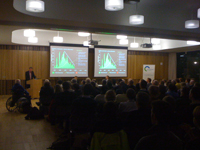 Standing room only!
The event was opened by Professor
Steven Stradling, Chair of the Transform Scotland Trust. Steven commented on the loss of respect by the general public for politicians and bankers as a result of recent financial scandals and, sadly, a loss of respect in scientists and professionals in general. This is particularly evident in the climate change/peak oil debate due to the intervention of ‘scientists’ presenting misinformation or at any rate contradictory analysis of data. Quite often these individuals are funded by vested interest groups from the coal, oil, mining and related industries but the effect is to confuse the general public and lead them to believe that the science is ambiguous. Yet, the solution to these and other problems must surely lie with science so greater efforts must be made to present the facts in a more clear and concise manner. One area where clarity is required is the topic of the day’s event, namely, the looming oil crunch when demand far outstrips supply and cost escalates adding enormously to the UK fuel bill? What will happen to the vast oil industry, can it reinvent itself?
Ian Macwhirter, Rector of the University, was in the chair for the evening. He introduced the event by mentioning the possibility that the end of cheap oil may lie no more than 3-4 years away. This will require a massive restructuring of all economies, yet there are opportunities for Scotland as a centre of alternative energy, if the government and business act in a visionary and concerted manner. It may surprise people to learn that Scotland still has a major road vehicle manufacturer in Alexander Dennis and there must surely be opportunities to move into the development of new types of more efficient engines. Yet the UK and Scottish governments are still acting as if the age of oil was going to go on without end. Motorway construction is still the main area of transport expenditure rather than investment in public transport or cycling infrastructure. The recent car scrappage scheme is another example of continuing the business as usual model. The two speakers tonight would look at two aspects of the debate, namely, the looming oil deficit and what public transport can do to help reduce oil dependency.
Jeremy Leggett, Executive Chairman of Solarcentury, mentioned the disparity between the way magazines promote the use of oil as if no end were in sight, in sharp contrast to what the science is telling us. Jeremy has been working with a multi-company group (the Industry Taskforce on Peak Oil and Energy Security) in an attempt to accurately quantify oil availability. It has concluded that global oil depletion presents a high risk. For example, US oil production has declined by 70% in recent years and helps to explain the keen US interest in the Middle East. Norwegian and UK production has also been declining since about year 2000 and global oil discoveries have declined for the past two decades. Oil production infrastructure at existing wells is also deteriorating from age and the corrosive nature of oil itself. Demand will exceed supply by about 2014 and it would require the discovery of six Saudi Arabian type oil fields by 2030 to arrest this decline – an unlikely event. Jeremy concluded that the UK needs to act now if a major economic disaster is to be averted, never mind the need to act for climate change concerns.
Steven Stewart, Director of Corporate Communications for Stagecoach Group, spoke of the fact that transport is the most important sector that will be affected by oil depletion. It is unrealistic to expect the private car to be replaced overnight by non fossil fuel vehicles but huge reductions in national oil demand could be achieved by intelligent car use, with public transport used for commuter journeys and the car for the weekend. 97% of transport runs on oil with road transport contributing about 25% of UK carbon dioxide emissions. Stagecoach uses 336m tonnes of diesel a year to run its services and it should be remembered that the group also runs rail services, which is very energy efficient compared to air or road, so this is one area where investment should be concentrated. The UK has only 35% rail electrification, which is poor compared to many other countries, and High Speed Rail is probably about 20 years away and with a huge price tag in the region of £30b+. Technological innovations may come along but not in time so there is a need to concentrate effort on behaviour change leading to increased use of public transport with reallocation of road space from the car to public transport and cycling. Other issues that should be addressed is the reason why bus companies pay fuel tax when airlines do not, or the scrapping of bus lanes in some cities with the result that public transport offers no time advantage compared to the car, hence discouraging modal shift. Government leadership is required in many such areas so that the industry has clear working parameters.
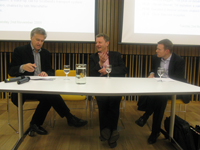
Chair Iain Macwhirter and speakers Jeremy Leggett and Steven Stewart.The speaker presentations were followed by a lively
debate that covered a wide range of issues, some of which are given below to give a flavour of the discussion:
- One member of the audience spoke of a zero political will to develop a rational transport policy and a lack of willingness to accept that there is a problem. The BP/Shell view is essentially the government view and there is a lack of political will to lead on such issues as congestion charging, which has been hugely successful in London.
- Another member of the audience asked why the Scottish Government’s spending plans are mainly car based such as motorway construction while not fully funding the Edinburgh tram scheme, which is a green option. The view was expressed that the UK has too much emphasis on centralised transport delivery whereas more local decision might be preferable.
- Another comment was on the lack of connection between the Scottish Government transport budget and the climate change bill. The comment was also made that the proposed Second Forth Road Bridge was a completely non-green solution.
- The question was raised as to why trolleybuses are not used in the UK, whereas relatively common in other European cities. Part of the answer may lie in culture and the associated infrastructure costs required for the installation of power cabling. It was, however, another example of one of the many green options that were around but ignored due to lack of consistent thinking and planning.
- The issue of cycling arose, with many journeys within Edinburgh two miles or less and ideal for cycling solutions. Segregated safe cycle lanes have led to huge modal shifts in Europe with many cities having 30-40% of commuters on cycles, yet the UK seems to resist this relatively cheap option. The Scottish cycling budget is very small and diminishing, yet an extra £150m had been found in the transport budget for road building.
- Other issues discussed were the need to expand electricity generation at local level and to look at micro-generation in a more serious way. Nuclear is often promoted as a quick solution but one member of the audience commented on the shortage of uranium as a resource. Apart from that, it was felt that the nuclear industry was fighting a guerrilla war against renewables in an effort to promote their own interests. The effectiveness of carbon capture at source was also questioned and whether it actually fits in with a peak oil scenario. It still seems to be a technique undergoing development and not actually a viable option at the moment.
- The final topic covered deregulation and the disastrous effect it has had on transport planning, integration and efficiency. Politicians should have dealt with this issue but once again have given into vested interest. They need to show leadership on this and other issues because the free market will certainly not solve the problem of the oil crunch and global warming.
The event concluded with a drinks reception and an opportunity for attendees to network and carry on the discussion.
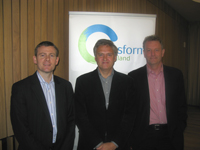 Thanks to the speakers (Steven Stewart, Iain Macwhirter and Jeremy Leggett, above), The University of Edinburgh for hosting the event, and First ScotRail for their help with speakers' travel to the event.